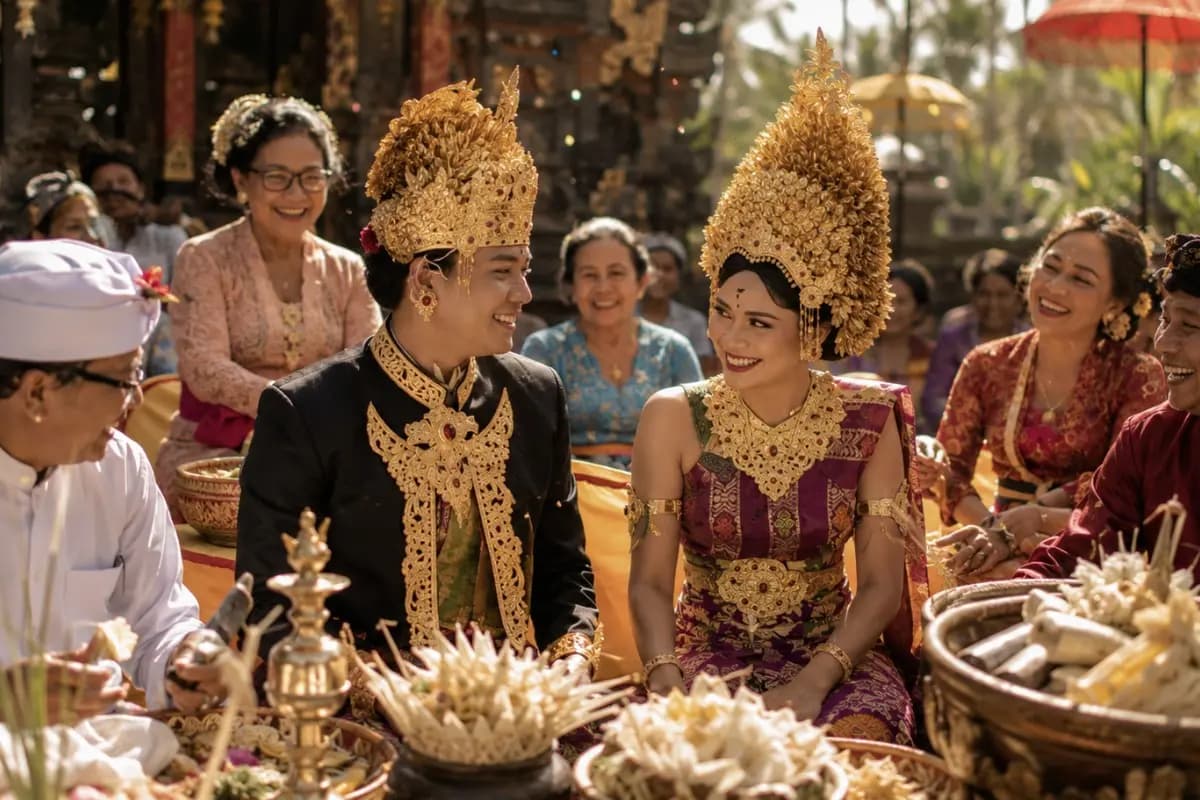
Known for diverse local customs, Balinese wedding traditions are entirely different from those of any other kind of wedding worldwide. Customs and traditions still strongly influence the ceremonies, making it deeper in terms of rituals.
If you are curious about the wedding, you are already in the right place. Discover more about Balinese wedding traditions here to enrich your knowledge of Indonesia’s rich cultures from Bali point of view.
What Makes a Balinese Wedding Different From a Western Ceremony?
Balinese culture plays a major role in making weddings on the island entirely different from a Western ceremony. The tradition is not limited to taking a vow in front of a priest, and afterwards, the couple is legally married.
The differences between a Balinese Wedding ceremony and a Western one are the length and ritual structure. The Western one may center on the processional, readings, traditional vows, exchange of rings, and the declaration of marriage, and the recessional.
Meanwhile, a wedding becomes a Balinese Ceremony where marriage is also a religious and family transition involving the couple, their ancestors, their extended families, and their relationship with the divine. Ceremonies usually include prayers, sacred offerings, purification, blessings, and worship at a family temple or merajan.
The Meaning Behind Marriage in Balinese Hindu Culture
In Hindu culture, a traditional Balinese wedding has its own significance. Hindu guidance describes wiwaha saṁskāra as part of a process of spiritual sanctification, with couples expected to enter married life prepared emotionally, mentally, socially, spiritually, and economically.
Marriage becomes a sacred duty, as Balinese Hindu tradition connects the wedding with the responsibilities of adult life. Through marriage, a couple begins a household in which they are expected to support one another, fulfill religious obligations, and participate in family and community.
How an Auspicious Wedding Date Is Chosen
Besides considering what kind of restaurants in Bali to celebrate the wedding after the ceremonies, a couple should discuss an auspicious wedding date through wariga. It is a traditional system used to assess the quality of particular days for ceremonies.
Since wariga calculation can be complex, families commonly seek guidance from someone knowledgeable in Balinese calendrical traditions rather than selecting the date independently. Research on Balinese Hindu ceremonies notes that ritual practices can vary between regions while remaining grounded in shared religious principles.
As part of Bali’s cultural traditions, the purpose of choosing dewasa ayu is not simply to find a “lucky date.” It reflects a desire to begin married life at a time considered appropriate spiritually and harmoniously for both couples.
How the Journey to Marriage Begins Before Any Ceremony
A couple who wants to marry with Balinese wedding culture may begin with five stages before any ceremony is held. All of these should be followed to make the marriage process go smoothly.
- The couple and families begin the conversation: Both families discuss the couple’s intentions, family approval, customary responsibilities, the location of the ceremony, and how the marriage will be recognized within the wider family and desa adat (village community).
- Preparing for married life: Preparation emphasizes mental, physical, cultural, and religious readiness before a couple enters marriage. It reflects an important principle of pawiwahan, in which the ceremony is not considered the beginning of responsibility.
- Families begin planning the religious requirements: Families begin preparing ceremonial offerings and selecting an auspicious wedding date in advance of the Balinese Hindu wedding.
- Asking for blessings and family support: It is one of the Balinese wedding customs, as couples may formally seek their parents’ blessings and express their gratitude for the care they have received.
- The wedding is the culmination of a longer transition: The couple commits, families have become involved, practical and religious responsibilities have been discussed, an appropriate date may have been chosen, and preparations for the ritual have begun.
These stages show that wedding traditions in Bali do not begin when the bride and groom arrive at the ceremony site. It is deeper, as the couple is involved in the ceremony that makes a transition sacred and visible.
Traditional Attire and What Each Piece Symbolizes
Balinese wedding attire has its own meanings, as each piece symbolizes important culture and traditions. To learn about each costume symbol for the bride and groom, see this description of traditional attire.
- The Bride’s Gelung Agung: A gold flower ornament in a triangular composition recalling Mount Agung, which holds an important place in Balinese sacred geography. The flowers themselves are associated with beauty and fertility.
- Petitis and Forehead Ornaments: Traditionally, these ornaments are associated with calmness and peace of mind.
- Flower and gold: Balinese flowers such as sandat and Payas Agung jewelry are associated with purity, sacredness, durability, preciousness, and elevated status.
- Badong: It is a necklace that symbolizes authority and dignity for both males and females, although its size, form, and decorative treatment may differ.
- Pending or Bebekeng: The bride will wear an ornate belt or waist ornament, namely bebekeng, which is associated with self-control, the ability to restrain impulses, and maintain personal discipline.
- Bracelets and Arm Ornaments: Gelang Kana represents introspection and self-awareness, while the Naga Satru bracelet symbolises strength.
- The Groom’s Headpiece: It is known as destar or udeng, which symbolizes calm thinking, mental focus, adaptability, and strength.
- Keris: Historically, this dagger is connected with status, nobility, strength, and masculine identity.
- Songket, Prada, Kamen, and Saput: These combinations of textiles create the ceremonial distinction of the clothing, while their arrangement follows ideas about how different parts of the body should be treated and adorned.
Balinese wedding attire is not simply a collection of beautiful garments. The entire body becomes part of the ceremony, as it is rich in symbolism for both bride and groom.
Music, Dance and the Community Celebration
In Bali wedding traditions, music, dance, and community celebrations also play a huge part. These all transform the occasion into a much broader social celebration, which makes everyone in the ceremony.
Traditional gamelan music may accompany the audience during ceremonies, including marriage. In addition, some families organise Balinese dancing as part of the reception or larger celebration, especially for a big gathering.
Food and Offerings at a Balinese Wedding
In Balinese weddings, the organizers prepare banten, which is used as Sarana Upakara, or ritual means through which prayers and acts of devotion are expressed. It contains flowers, leaves, rice, cakes, fruits, and agricultural produce that carry religious, aesthetic, philosophical, and symbolic significance.
Besides, the families also served food for the community. Recipes and dishes vary according to village, family, budget, scale of the celebration, and contemporary preferences, so you may find different types of food when attending a Balinese wedding.
Wedding food may include rice, sate lilit, pork satay, lawar, ribs, traditional cakes, coffee, and tea. Even though it is not a fixed menu, you may find these in a regular wedding and enjoy them after the whole ceremony is done.
What Happens in the Days After the Wedding
Mejauman, also called mepamit, becomes one of the best-known post-wedding traditions. At this stage, the newly married couple visit the bride’s family home and pray at the family shrine, as the bride enters her husband’s family while respectfully taking leave of the ancestors.
To celebrate the bride’s arrival in the husband’s ancestral and religious household, the couple then visits the groom’s family shrine, known as mewidhi widana. It becomes the beginning of the newly married couple’s life.
What to Know Before Attending a Balinese Wedding as a Guest
Before going to the Balinese wedding ceremonies, you have to understand what to know first. It helps you be respectful of the bride and groom, their families, and the community with its local customs and traditions.
- Do not forget to ask about the dress code, as family may request you to wear Balinese traditional attire.
- Be careful of each area that may be sacred, such as the family shrine where prayers and offerings are taking place.
- Pay attention to offerings, as small and large offerings may be placed throughout the wedding area near shrines, entrances, ceremonial statues, and pathways.
- Follow the ceremony but do not participate in it, as you can observe how the family does and follow instructions given by the religious attendants.
- Ask before photographing sacred moments because not every moment should automatically become a photo opportunity.
You should follow all the things above to make your attendance feel comfortable. These all help you prevent distracting family and community members running the religious ceremonies for the couple getting married in the shrine.
Where Sacred Tradition Meets Modern Balinese Life
In today’s era, Balinese wedding traditions blend sacred and modern life. It is possible to simplify a modern Balinese wedding without diminishing its significance, as it still involves substantial preparation, offerings, labor, time, and expense.
Families can still emphasize maintaining the core meaning and sacred characteristics of the Hindu marriage ceremony, even though the sequence is made more practical. It makes the wedding ceremony both elegant and meaningful.
Carrying These Traditions Into the Next Generation
Families should carry on Balinese wedding traditions to the next generation since they can be adapted to contemporary life. It helps preserve the tradition, as future generations maintain wedding traditions in the modern era.
For a better insight into Balinese culture, you can visit The Wonderspace website. We are ready to give you a guide for exploring Bali for couples, families, and groups, so the trip goes smoothly.